

ECU Remapping Explained: What It Changes in Your Engine
ECU remapping changes calibration tables and control strategies inside an engine control unit. These settings translate accelerator demand, sensor data and protection limits into commands for fuelling, ignition, boost, torque and emissions systems. A responsible remap works within the verified vehicle hardware and preserves essential safeguards.
What the ECU controls
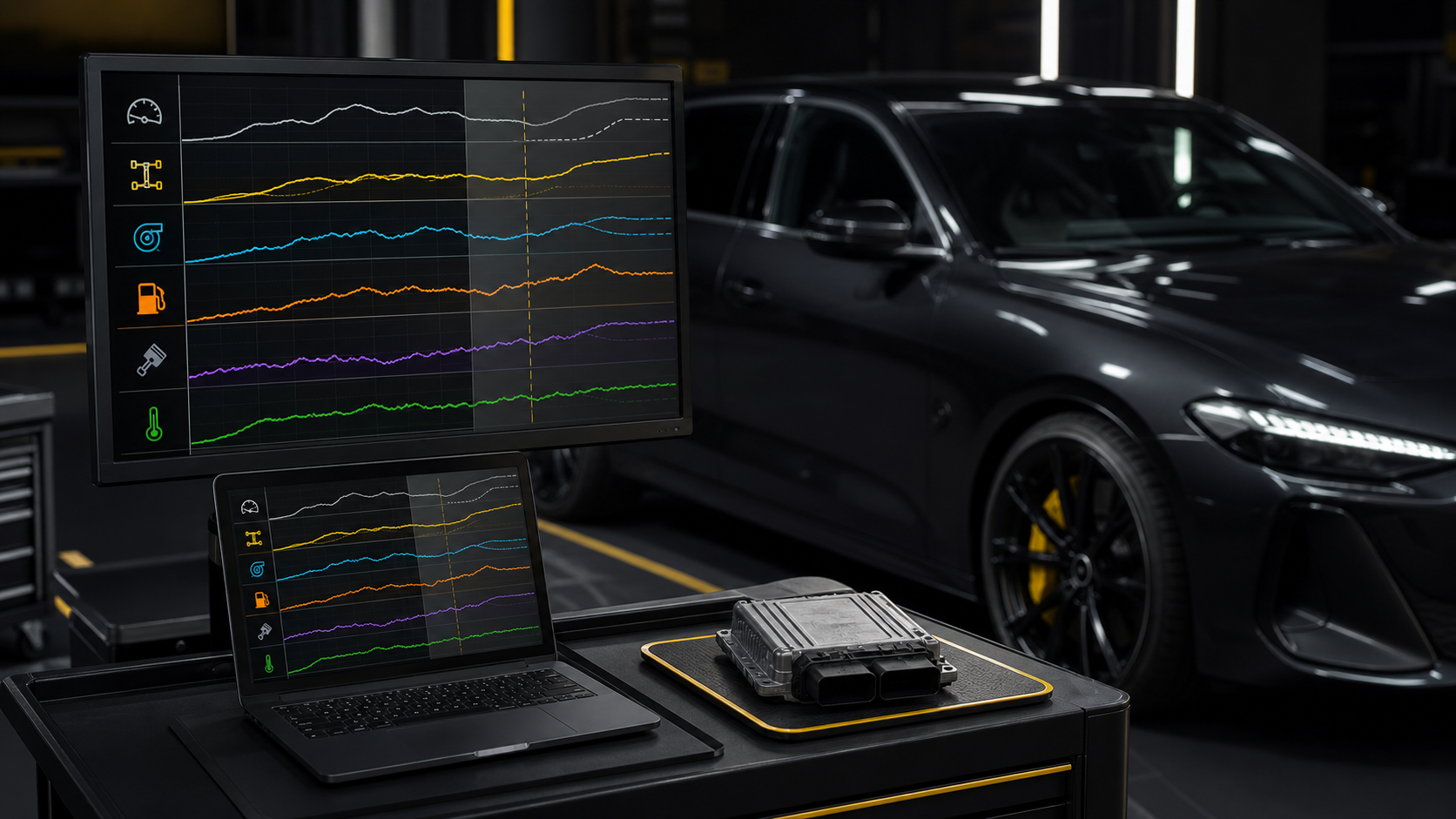
The engine control unit receives signals such as engine speed, airflow, pressure, temperature, throttle position and exhaust feedback. It calculates actuator commands for injectors, ignition, turbo control and other systems. Modern ECUs also exchange torque requests and limits with the transmission, stability control and body modules.
Driver-demand mapping
The accelerator pedal usually represents a requested torque rather than a direct throttle cable position. Driver-demand maps shape how much torque is requested at different pedal positions and engine speeds. Changing them can make the vehicle feel more responsive without creating the same increase at every operating point.
Torque model and limiters
Many ECUs estimate engine torque and use multiple limiters to protect the engine, gearbox, traction system and thermal condition. A calibration should remain coherent: increasing one request while leaving related models inconsistent can cause intervention, diagnostic faults or poor drivability.
Turbo boost control
On turbocharged engines, calibration manages target pressure and the actuator used to control it. Safe changes consider turbo efficiency, intake temperature, exhaust temperature, air-path leaks and hardware limits. A higher headline pressure is not automatically better and may increase heat or compressor stress.
Fuel quantity and pressure
Diesel and petrol strategies differ, but both must deliver appropriate fuel quantity and pressure within injector and pump capability. Fuelling changes affect combustion temperature, emissions and component loading. Visible smoke or excessive enrichment is not evidence of a good calibration.
Ignition timing
Petrol engines use ignition timing to balance torque, efficiency, knock resistance and temperature. The appropriate value depends on fuel quality, load, speed and temperature. Knock-control systems are protection, not permission to use an unsuitable calibration or fuel.
Air–fuel ratio and lambda targets
Target mixture changes with operating mode. Closed-loop feedback, catalyst protection and full-load requirements must remain coordinated. Altering targets without understanding sensor range, fuel system capacity and exhaust temperature can harm reliability and emissions performance.
Throttle and load control
Electronic throttle is used for torque control, emissions, traction and stability functions. A remap may alter response but should preserve predictable low-speed control and safety interventions. Aggressive pedal mapping can feel powerful while making smooth driving more difficult.
Rev, speed and temperature limits
Limiters exist for component and vehicle protection. Raising them requires evidence that the engine, valve train, tyres, brakes, transmission and cooling are suitable. Removing temperature-based protection or warnings is not responsible remapping.
Diesel particulate filter and emissions strategy
Modern engines coordinate exhaust temperature, particulate-filter regeneration, catalyst operation and diagnostic monitoring. A road vehicle should retain functioning emissions systems and remain compliant with applicable requirements. Remapping should not be used to hide faults or disable monitoring.
Automatic transmission interaction
The engine and transmission exchange torque information during shifts and clutch control. More engine torque can exceed clutch capacity or temperature limits even if the engine remains healthy. Transmission condition and software strategy must be considered separately.
Why the same engine can have different factory outputs
Manufacturers may use related hardware across several outputs, but differences can include turbochargers, cooling, injectors, transmissions, emissions certification and component specifications. Shared engine family does not prove that every version can safely use the highest factory calibration.
Reading and writing the ECU
The provider identifies the ECU hardware and software, reads the existing file or retrieves an appropriate original, creates a verified backup and writes the calibration using a supported method. Stable power and communication are essential. Some ECUs require bench access or secure online procedures.
Generic, development and vehicle-specific files
A well-developed file can suit a known standard vehicle, while vehicle-specific changes may be needed for legitimate hardware differences or goals. Marketing labels such as “stage” or “custom” do not define quality. Ask what was changed, what assumptions apply and how the result is validated.
What a remap does not change
Software does not strengthen a worn clutch, enlarge an injector, repair a leaking turbo hose or improve poor fuel. It cannot make an unhealthy engine safe under more load. Mechanical condition and maintenance remain fundamental.
How results should be validated
- Check for stored and pending fault codes.
- Confirm cold and hot starting.
- Assess idle and low-speed drivability.
- Review relevant boost, fuelling and temperature data.
- Check transmission and clutch behaviour.
- Compare measured results with stated goals.
- Retain original and final software records.
A dynamometer provides controlled measurement when used correctly, while road validation must remain lawful and safe.
Fuel economy claims
Efficiency can improve in some operating conditions if the driver uses the available torque to reduce throttle demand or shifting. It can worsen when performance is used. Compare consumption over similar routes and conditions rather than relying on a short dashboard reading.
Before booking ECU remapping
Resolve warning lights, maintenance issues, fluid loss, smoke, misfire and abnormal noise first. Declare modifications and intended use. Confirm insurance, finance, lease and warranty obligations. Ask how the original file, recovery and post-write checks are handled.
Read whether ECU remapping is safe for the full checklist.
ECU remapping in Doncaster
Smart Auto Keys can assess suitable vehicles from Armthorpe and explain the calibration process before work. Goals should be realistic and matched to the exact engine, transmission, hardware and condition.
Visit ECU remapping, use vehicle diagnostics, check the areas we cover, or contact Smart Auto Keys.
Frequently asked questions
Does a remap only change boost?
No. Torque requests, fuelling, ignition, throttle, limits and protection strategies may all interact.
What is a Stage 1 remap?
It is a marketing label often used for standard hardware; ask for the actual assumptions and changes.
Can software repair a mechanical fault?
No. Faults should be diagnosed and repaired before tuning.
Will fuel economy improve?
It may under comparable light-load use, but performance use can increase consumption.
Can the original software be restored?
Usually, when a verified original file was retained and the ECU remains supported.
Why is stable power important?
Voltage loss during writing can interrupt programming and leave the ECU unable to operate.